Cost vs Experience: Are Himalayan Motorcycle Tours Worth It?
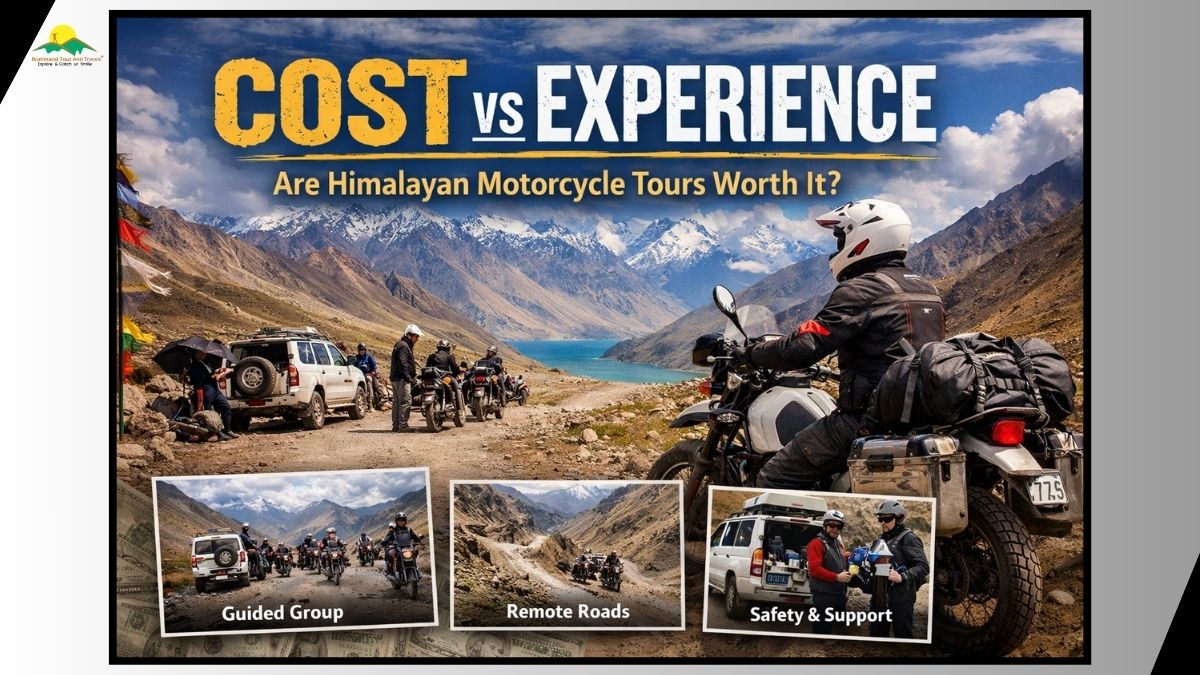
For many adventure riders in Europe, Australia, or the Americas, India represents the "Holy Grail" of motorcycle touring. It is wild, chaotic, and incredibly beautiful. However, when you start planning a 22-day expedition and look at the price tag-often starting around US$ 3,500-it is natural to pause.Is it really worth spending that much money to ride a motorcycle in a developing country? Could you just rent a bike and do it yourself for half the price? These are fair questions. To help you decide, let’s break down the actual value of these long-format expeditions and see if the experience justifies the investment.
What is the Real Daily Cost of a Himalayan Tour?
When you see a lump sum of $3,500, it looks steep. But when you break it down, the math tells a different story. A comprehensive 22-day Himalayan Heights Motorcycle Tour works out to approximately $160 per day.For international travelers accustomed to tour prices in the Alps or the Rockies, this is remarkably competitive. But what does that $160 actually buy you in the Himalayas? It is not just a rental fee; it is an all-inclusive ecosystem designed to keep you moving.
- The Machine: A raid-ready Royal Enfield Himalayan, maintained daily.
- Fuel & Oil: Covering 3,270 km (2,000 miles) of mountain riding.
- Accommodation: 21 nights in premium hotels, resorts, and luxury camps (like The Suryaa in Delhi or Swiss tents in Nubra).
- Logistics: Inner Line Permits (ILP) for restricted areas like Hanle and Umling La, which can be a bureaucratic nightmare for foreigners to obtain alone.
- ** sustenance:** Breakfast and dinner daily, ensuring hygienic, safe food.
When you attempt to replicate this level of comfort and safety independently, the "savings" often evaporate quickly once you factor in individual booking rates and fuel costs.
Can I Do It Cheaper on My Own?
Technically, yes. You can rent a bike in Delhi or Manali and head north with a map. However, the "DIY discount" often comes with hidden costs that aren't financial-they are paid in stress, time, and safety.Solo india motorcycle tours are fraught with invisible challenges. If your clutch cable snaps in the middle of the More Plains (a vast high-altitude desert), you are on your own. There is no cell service, no mechanic, and no tow truck. You might wait hours or days for help, or pay an exorbitant fee to a passing truck driver to haul your bike to the nearest town.Furthermore, navigation in the Himalayas isn't just about following Google Maps. Road conditions change hourly due to landslides or glacial melt. A guided tour adjusts the route in real-time, ensuring you don't get stuck on a blocked pass. The "cost" of a tour includes the peace of mind that allows you to focus 100% on the riding, rather than worrying about survival logistics.
The Value of Safety and Support
For foreign riders, the altitude is the biggest variable. Riding at 19,000 feet (Umling La) is physically demanding. Altitude sickness (AMS) can strike anyone, regardless of fitness.This is where the value of the best international tour operators in india becomes undeniable. They don't just provide a guide; they provide a safety net.
- Oxygen on Demand: Support vehicles carry medical oxygen cylinders-a non-negotiable safety tool at extreme heights.
- Mechanic on Duty: A certified mechanic rides with the group. Punctures are fixed while you drink tea; engine issues are sorted overnight.
- Backup Vehicle: If you fall ill or are too tired to ride, you can hop into the 4x4 support vehicle while your bike is loaded on the back.
On a solo trip, a severe case of AMS or a mechanical failure ends the trip. On a supported tour, it is just a minor hiccup.
The "Priceless" Access to Remote Areas
There is also the factor of access. The Himalayas are a sensitive border region. Foreigners require specific permits to visit areas like the Zanskar Valley, Hanle (home to the dark sky reserve), and the border regions near Pangong Tso.Navigating the Indian bureaucracy to get these permits can take days of your vacation time. Tour operators handle this paperwork in advance. They have the relationships and the know-how to get you through the checkpoints smoothly. Can you put a price on not standing in line at a government office for three days? Most riders would say yes.
Conclusion: An Investment in a Lifetime Memory
Ultimately, the question isn't "is it expensive?" but rather "what is the return on investment?"A Himalayan tour is not a weekend getaway; it is a life-altering expedition. It is 22 days of conquering the world's highest roads, bonding with a team of like-minded adventurers, and witnessing landscapes that look like they belong on Mars.When you pay for a premium package, you are buying the certainty that the trip will happen. You are buying the expertise that turns a grueling challenge into an enjoyable adventure. For the serious rider, the memories of cresting Umling La or seeing the Milky Way over Hanle are worth far more than the price of admission.
